
Get all your questions about baby teeth answered here. This article was written with love and care for all you moms and dads out there.
Por Dra. Camila, Cirurgiã-Dentista
Hi, moms and dads! I’m Camila, a dentist and mom. I know exactly how that mixture of anxiety and curiosity feels when our little one’s first tooth starts to loosen. 😊
Is it the right age? Is it normal for it to hurt? What if it doesn’t fall in the “right” order?
Take a deep breath! Today we’re going to talk about everything you need to know about when baby teeth fall out. I’ve put a lot of care into preparing this comprehensive guide, based on my experience as a mother and my guidance as a dentist.
What Are Baby Teeth and Why Do They Exist?
Baby teeth, or deciduous teeth as we technically call them, are our little ones’ first teeth. They start to appear around 6 months of age and complete the smile by the age of 3.
But why did nature create these “temporary teeth”? Very clever of her! Baby teeth serve as “space holders” for permanent teeth, help with proper chewing of food, and are essential for speech development.
💡 Fun fact from Mom Camila: There are 20 baby teeth in total—10 upper and 10 lower. Each one has its own special moment to arrive and then depart!
At What Age Do Baby Teeth Start to Fall Out?
Before mentioning the age at which baby teeth usually start to fall out, I will insert a table with their average age at birth below:
Average Age of Birth and Teeth Replacement
General Chronology of the Middle Ages of Baby Teeth Replacement (5 to 13 years old)
The “big switch” to adult teeth usually begins between the ages of 5 and 7, but don’t worry if your little one is a little outside that age range. Every child develops at their own pace, and that’s completely normal!
The entire process can last until the age of 12 or 13. Yes, it is a long process, but it is gradual and natural. The last baby tooth is usually one of the molars at the back.
Factors That Influence Time
Several factors can influence when baby teeth begin to fall out:
- Genetics: If you, as parents, had early or late teeth, it is likely that your children will follow the same pattern.
- Nutrition: A balanced diet promotes proper development
- Oral hygiene: Healthy teeth follow the natural schedule better
- Individual factors: Every child is unique, and that’s beautiful!
Order of Baby Teeth Loss by Age
| 🦷 Tipo de Dente | 📅 Idade (anos) | 📍 Ordem | 💭 Observações |
|---|---|---|---|
| Incisivos Centrais Inferiores | 5-7 | 1° | Primeiros a cair |
| Incisivos Centrais Superiores | 6-8 | 2° | Logo após os inferiores |
| Incisivos Laterais Inferiores | 7-8 | 3° | Ao lado dos centrais |
| Incisivos Laterais Superiores | 8-9 | 4° | Completam a frente |
| Caninos Inferiores | 9-12 | 5° | “Dentinhos de vampiro” |
| Primeiros Molares | 9-11 | 6° | Dentes do fundo |
| Caninos Superiores | 10-12 | 7° | Após os molares! |
| Segundos Molares | 10-13 | 8° | Últimos a partir na infância |
| Terceiros Molares (Sisos) | 17-25 | 9° | Nem sempre nascem, podem ser extraídos |
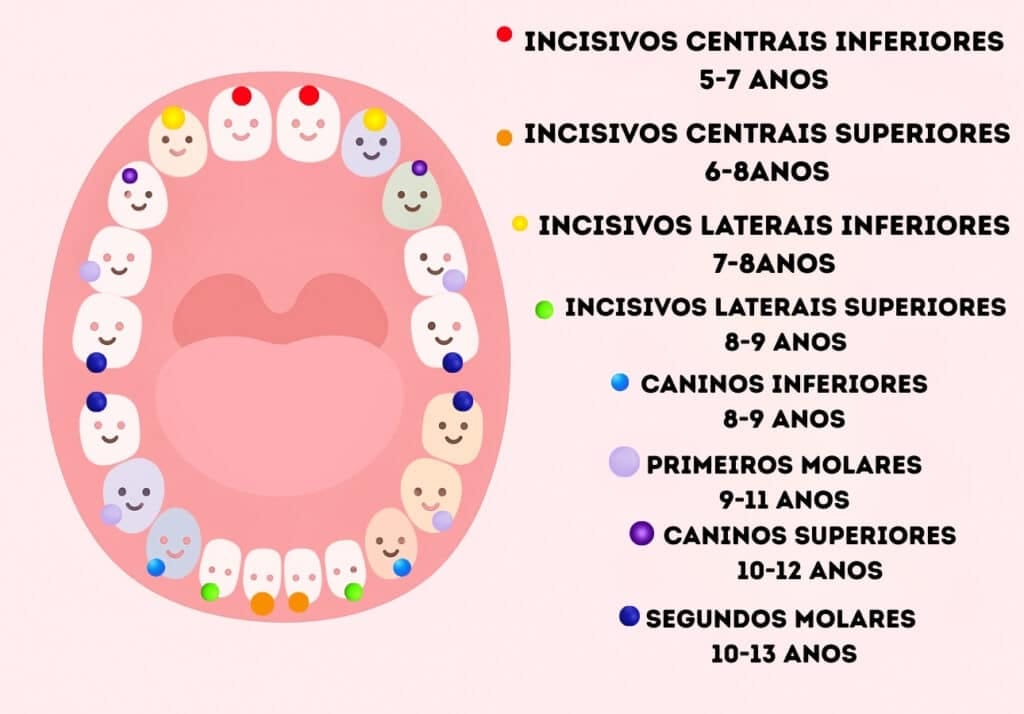
Central Incisors (5-7 years) – The Pioneers
Ah, what a special moment! The lower central incisors are usually the first to say goodbye. It’s exciting to see that toothless smile for the first time, isn’t it?
Usually, the bottom teeth loosen first, followed by the top teeth. There may be a difference of a few months between them, and this is absolutely normal. My daughter lost her first tooth at 5½ years old, and it was a party at home!
Lateral Incisors (7-8 years old) – The Companions
Right after the central teeth, it’s time for the lateral teeth—the ones next to the front teeth. Follow the same logic: lower teeth first, then upper teeth.
At this stage, it is common for children to have that super cute smile that is characteristic of their age. It is a phase that passes quickly, so take advantage of it to take lots of pictures! 📸
Canines – The “Vampire Teeth” (9-12 years old)
Canines have an interesting feature: the lower ones fall out before the upper ones, but in the middle of this process, the molars also join in. It’s like a choreography coordinated by nature!
💡 Tip from Mom Camila: Canines sometimes take a little longer to soften, and that’s okay! They are naturally more “stubborn” teeth.
Molars (7-13 years old) – The Fund Workers
Molars are the teeth that work hardest when chewing, which is why they are sometimes reluctant to fall out. There are first molars (which fall out between the ages of 9 and 11) and second molars (10 to 13 years old).
This is the stage that varies most among children. Some children may have all their molars replaced by age 11, others only by age 13, and both are fine!
Tip:
Keep a record of the dates when the first teeth appear. This can help monitor development and provide useful information to the dentist during appointments.
Another great tip is the tooth box or tooth book. You can put the teeth in the correct order and also record the date.
It’s still a hit here at home! My boys are still losing their baby teeth. It’s totally worth it!!! Since I have two boys, I bought two blue tooth boxes. Each one takes care of his own, and what’s more, they take great care of them.
Angie Toothpaste Holder Blue One Size Fits All

Pink Dental Album, Angie, Pink, One Size Fits All

🌸 Spaces that inspire and care
Discover other projects created with delicacy and purpose, to welcome each stage of motherhood with affection:
- 💎 Mommy’s Jewel Blog – Name inspiration, care and self-esteem for the maternal journey.
- 🎵 Enchanted Smile Channel – Charming songs and stories that teach with lightness.
How to Identify If a Tooth Is a Baby Tooth?
Sometimes we are unsure, especially when the permanent molars have already come in. Here are the main differences:
- Size: Baby teeth are smaller and more proportional to the child’s mouth.
- Color: They tend to be whiter than permanent ones.
- Shape: They are more rounded and less pointed.
- Root: When they fall, you can see that the root has been “absorbed.”
Special Situations with Baby Teeth
Baby Teeth That Don’t Loosen – Is This Normal?
Calm down, Mom, calm down, Dad! Sometimes a tooth decides to be more “stubborn” and doesn’t loosen at the expected age. This can happen for a few reasons:
- Lack of space: The permanent tooth may be growing in a different position.
- Agenesia: In rare cases, the permanent tooth may not exist.
- Individual variation: Every child has their own pace
⚠️ When to be concerned: If the tooth is significantly behind the expected age (more than 1-2 years), it is worth consulting a pediatric dentist.
Baby Teeth That Don’t Fall Out
There are rare cases where baby teeth decide to “retire” in the mouth and do not fall out on their own. This can happen when:
- The corresponding permanent tooth does not develop
- The permanent tooth is poorly positioned.
- Was there any previous trauma?
What to Do When a Permanent Tooth Comes in Backwards?
Oh, what a shock when we see a tooth coming in behind a baby tooth that hasn’t fallen out yet! But relax, this is more common than you might think, especially with the lower incisors.
In most cases, with time and movement of the tongue, baby teeth fall out naturally. If they persist for more than 2-3 months, the dentist can provide a little “help.”
Essential Care for Baby Teeth

Proper Brushing by Age
Guys, I’m going to let you in on a secret: taking care of baby teeth is just as important as taking care of permanent teeth! They are the foundation for everything.
Up to 2 years old: We, the caregivers, do all the brushing with a soft brush and fluoride-free toothpaste or with minimal fluoride.
2-6 years old: We can let the child “play” at brushing, but we always finish it ourselves. Use fluoride toothpaste, but only an amount the size of a grain of rice.
6+ years old: The child can start brushing alone, but with supervision. We increase the amount of toothpaste to the size of a pea.
Use of Toothpaste – Amount and Type
💡 Golden rule for amount:
- 0-2 years old: fluoride-free or minimal amount
- 2-6 years old: rice grain amount of fluoride toothpaste
- 6+ years old: pea-sized amount
Dental Floss for Children – How and When
Yes, children use dental floss! As soon as the little teeth start touching each other (around 2-3 years old), we can already introduce dental floss into the routine.
In the beginning, we do the flossing. There are colorful flosses with fun shapes that make the moment more enjoyable. From 8-10 years old, they can use it by themselves.
Food and Oral Health
Diet directly affects the health of little teeth. Some practical tips:
- Limit sugars: Especially between meals
- Offer water: Helps clean the mouth naturally
- Fruits in moderation: They’re great, but they have natural sugar
- Cheeses are friends: They help neutralize mouth acidity
Common Problems in Baby Teeth
Cavities in Baby Teeth
I’ll be very direct: cavities in baby teeth ARE a problem! It’s not because they’re going to fall out that we can ignore them. Cavities can cause pain, infection, and even harm the permanent tooth that’s forming underneath.
⚠️ Signs of cavities:
- Dark or whitish spots
- Pain when chewing or spontaneous pain
- Sensitivity to cold/heat
- Persistent bad breath
Dental Fluorosis
Fluorosis happens when there’s excess fluoride during tooth formation. It can cause white or yellowish spots. That’s why it’s important to use the right amount of toothpaste!
Traumas and Blows to the Teeth
Children fall, children bump their mouths, it’s part of life! But traumas to baby teeth deserve attention, as they can affect the permanent teeth that are forming.
Emergencies: What to Do After Blows to the Teeth
🚨 IMPORTANT: In any dental trauma, seek a pediatric dentist as quickly as possible, even if it seems “minor.
If the Tooth Breaks
Immediate action:
- Stay calm (I know it’s difficult!)
- Rinse the mouth with clean water
- If you find the little piece, store it in milk
- Cold compress on the outside of the face
- Urgent dentist!
If the Tooth Becomes Loose
A loose tooth after a blow is different from a naturally loose tooth. Avoid touching or trying to “test” if it’s loose. Soft diet and dentist on the same day.
If the Tooth Becomes Crooked
Don’t try to “straighten” the tooth! This can cause more damage. Take a photo (if possible) and go straight to the dentist.
If the Tooth Goes Into the Gum
This is an emergency! The tooth may have been “pushed” into the bone. Immediate evaluation is essential to avoid damage to the permanent tooth.
If the Tooth Falls Out Completely
Unlike permanent teeth, baby teeth that fall out due to trauma are usually NOT reimplanted. But it’s essential to evaluate whether there are fragments and check the condition of the permanent tooth.
If the Tooth Becomes Dark
A dark tooth after trauma may indicate that the “little nerve” (pulp) of the tooth has died. Even though it’s a baby tooth, it may need treatment to prevent infection.
Baby Teeth and Baby’s Sleep
Ah, this phase… who hasn’t had sleepless nights because of little teeth coming in? It’s a challenging phase, but temporary.
Common symptoms of teething:
- Excessive drooling
- Irritability, especially at night
- Desire to bite everything
- Swollen and reddened gums
- Changes in sleep patterns
How to relieve discomfort:
- Cold teething toys (never frozen!
- Gentle massage on the gum with a clean finger
- Cold foods for older babies (fruit popsicles)
- Extra cuddles and patience ❤️

Making Oral Hygiene Fun
Guys, this is one of my favorite parts! Turning brushing into an enjoyable moment is an investment for life.
Strategies that work:
- Brushing songs: 2 minutes fly by with a fun song
- Colorful brushes: Let the child choose their special brush
- Brushing calendar: With stickers for each day completed
- Brush together: Children learn a lot by imitating
- Tooth stories: Make up adventures of the “little tooth soldiers”


Myths and Truths about Baby Teeth
❌ MYTH: “Baby teeth don’t need to be treated because they’re going to fall out anyway”
✅ TRUTH: Baby teeth do need care! They hold space and can affect the permanent ones.
❌ MYTH: “If the baby tooth hasn’t fallen out, you can pull it out at home”
✅ TRUTH: Never force a tooth out! If it’s way past due, consult the dentist.
❌ MYTH: “Baby teeth don’t hurt when they have cavities”
✅ TRUTH: Yes, it does hurt, and a lot! The structure is the same as permanent teeth.
❌ MYTH: “The earlier they fall out, the better.”
✅ TRUTH: Each tooth has its own timing. Too early can be problematic as well.
Warning Signs: When to See the Dentist
⚠️ Seek professional help if you notice:
- Severe or persistent pain
- Swelling in the gums or face
- Fever associated with dental problems
- Tooth erupting far outside the expected age range (± 2 years)
- Excessive bleeding while brushing
- Persistent bad breath even with good oral hygiene
- Permanent tooth coming in before the baby tooth falls out
- Any trauma to the teeth
- Spots or unusual coloring on the teeth
- Difficulty chewing
I want to share a brief story from a case I handled in my practice about four years after I graduated. One day, a mother came in with her five-year-old daughter. An adorable little girl, but you could see the sadness and shyness in her eyes. I was only able to perform her oral health assessment during the second appointment, as I don’t like to force a child to be examined if she doesn’t feel safe and confident.
At the second appointment, she agreed to be examined, and to my surprise, not a single tooth was free of cavities. Many issues were present, and the road ahead would be long. But with lots of patience, support, and the help of her parents, we were able to complete the treatment successfully, and that little girl started smiling again. She confided in me that she hadn’t been smiling because she felt shy and embarrassed. Being able to feel happy and smile again was a huge change for her.
I would like to emphasize that many times we might think that cavities in baby teeth are not a big deal because they will eventually be replaced. However, neglecting these issues can be costly—not only in terms of appearance, but also because of intense pain. Additionally, it can lead to future problems for your children. Therefore, never ignore an oral health issue. Always stay alert and take good care of your little ones’ smiles.
Which Tooth Is Already Permanent at Birth?
A curiosity that many parents don’t know: the first permanent molar (also called the “6-year-old tooth”) erupts WITHOUT any baby tooth falling out!
It appears behind the baby molars, way at the back of the mouth, between ages 5 and 7. That’s why many parents don’t even notice it and may confuse it with a baby tooth. But be careful: this tooth is meant to last a lifetime!
💡 Important Tip: The first permanent molar needs extra care! Since many parents don’t know it’s permanent, its care is sometimes neglected.
The Importance of Baby Teeth
Let me emphasize something fundamental: baby teeth are NOT just “temporary teeth.” They have essential functions:
- Proper chewing: Allows children to eat well and absorb nutrients
- Speech development: These are essential for correct pronunciation.
- Space maintainer: Keeps the place for permanent teeth
- Facial development: Contributes to harmonious facial growth
- Self-esteem: A healthy smile makes all the difference in a child’s confidence
So, moms and dads, take care of your children’s baby teeth with the same love and care you would give their permanent teeth!
Frequently Asked Questions (FAQ)
1. Is it normal that my 7-year-old son hasn’t lost any teeth yet?
Yes, it can be normal! Some children start losing their baby teeth later, and up to age 8 it is still within the normal range. If you are concerned, a consultation with a pediatric dentist can put your mind at ease.
2. Can I help “rock” my child’s loose tooth?
If the tooth is already very loose and causing discomfort, gentle movements may help. But never force it! The best thing to do is to let nature take its course. If it is causing discomfort when eating, consult your dentist.
3. My permanent tooth is coming in crooked. Is this normal?
Often, yes! Permanent teeth may appear “too big” or “crooked” at first. As the mouth grows and the tongue adjusts, many teeth settle into place naturally. However, it is always a good idea to follow up with an orthodontist.
4. My son swallowed his loose tooth. Is that a problem?
Don’t worry! Swallowing a baby tooth causes no problems. It will be eliminated naturally by the body. It’s more common than we think!
5. When should I stop brushing my child’s teeth?
Supervision should continue until at least 8-10 years of age. Even if the child brushes alone, always finish the job yourself or at least supervise. Fine motor skills are only fully developed at this age.
6. Is it true that thumb sucking or pacifier use can affect teeth?
If the habit persists after 3-4 years of age, it can affect tooth positioning and speech development. The ideal approach is to gradually wean the child off the habit before that age, always with great care and patience.
Read more about pacifiers in this article Pacifiers and Baby Oral Health
7. Do I need to take my child to the dentist before they have dental problems?
YES! The first appointment should be by the first birthday or 6 months after the first tooth appears. Preventive appointments are essential for teaching correct techniques and detecting problems early on.
8. Why do some baby teeth turn dark?
It could be due to trauma (even minor trauma that we don’t notice), deep cavities, or even medication. Dark teeth always warrant professional evaluation, as they may indicate that the tooth’s “nerve” is unhealthy.
9. My child grinds his teeth at night. Should I be concerned?
Bruxism (teeth grinding) is relatively common in children and is often related to growth, stress, or respiratory problems. It is worth getting an evaluation to identify the cause and, if necessary, use a night guard.
Read more about childhood bruxism in this article: Childhood Bruxism: Causes, Consequences, and How to Care for Your Child’s Smile
10. When can my child start using mouthwash?
Usually after the age of 6, when they can rinse and spit without swallowing. But it’s not mandatory! Thorough brushing with fluoride toothpaste and flossing are enough to maintain oral health.
Conclusion:
Moms and dads, remember: every child is unique and special! The milestones I have presented here are general guidelines. The important thing is to continue caring for your child, observe them lovingly, and don’t hesitate to seek professional help when you have questions.
The phase of losing baby teeth is beautiful and marks an important stage in our little ones’ growth. Enjoy every toothless smile, every story about the “tooth fairy,” and every special moment of this journey!
And always remember: you are doing a wonderful job! 💕
Warm Hugs,
Camila, Mommy Smile.
Reading Tip:
5 Dicas Essenciais para Reduzir o Impacto do Açúcar nos Dentes dos Seus Filhos
How to Make Brushing Your Teeth Fun: Effective Tips and Strategies